Aufgabenstellung

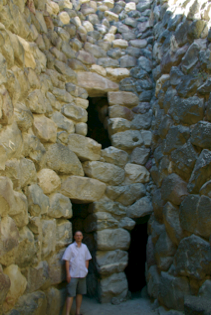
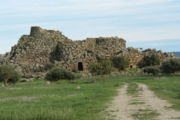
The nuraghe is the main type of ancient megalithic edifice found in Sardinia, developed during the Nuragic Age between 1900 and 730 BCE. Today it has come to be the symbol of Sardinia and its distinctive culture, the Nuragic civilization. More than 7000 nuraghi have been found, though archeologists believe that originally there were not less than 10,000.
Today, there are fewer than 7,000 nuraghes still existing in Sardinia, although their number was originally larger. Nuraghes are most prevalent in the northwest and south-central parts of the island.
According to the Oxford English Dictionary the etymology is “uncertain and disputed”: “The word is perhaps related to the Sardinian place names Nurra, Nurri, Nurru, and to Sardinian nurra ‘heap of stones, cavity in earth’ (although these senses are difficult to reconcile). A connection with the Semitic base of Arabic nūr ‘light, fire, etc.’ is now generally rejected.” The Latin word murus (‘wall’) may be related to it, as the old Italian word mora (‘tombal rock mound’), as used by Dante in his Comedy. However, the derivation: murus–muraghe–nuraghe is debated.
The typical nuraghe is situated in areas where previous prehistoric Sardinian cultures had been distributed, that is not far from alluvial plains (though few nuraghi appear in plains nowadays, as they were destroyed by human activities such as agriculture, dams and others) and has the shape of a truncated conical tower resembling a medieval tower (outside) or a beehive (inside). The structure’s walls consist of three components: an outer layer shaped like a tower (tilted inwards and made of many layers of stones whose size diminishes with height: mostly, lower layers consist of rubble masonry, while upper layers tend to ashlar masonry), an inner layer, made of smaller stones (to form a bullet shaped dome called "tholos", and where ashlar masonry is used more frequently), and an intermediate layer of very small pieces and dirt, which makes the whole construction very sturdy: it stands only by virtue of the weight of its stones, which may each amount to several tons. Some nuraghes are about 20 meters (60 ft) in height, the tallest one known, Nuraghe Arrubiu, reached a height of 25–30 meters. A spiral stone stair was built within the thick walls, leading to upper floors (if present) and/or to a terrace.